

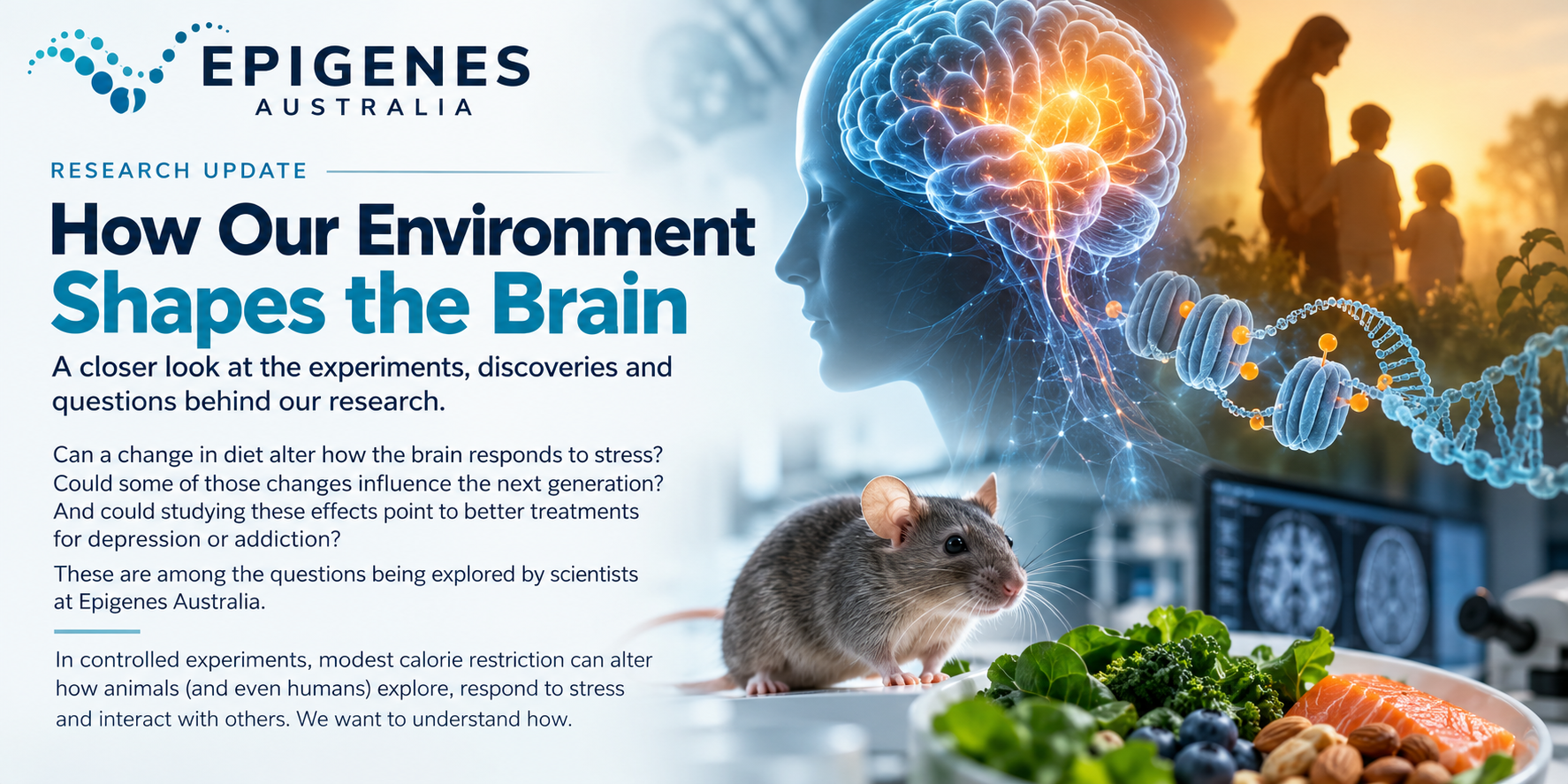
How Our Environment Shapes the Brain
A closer look at the experiments, discoveries and questions behind our research.
October 2026
Overview
Can a change in diet alter how the brain responds to stress? Could some of those changes influence the next generation? And could studying these effects point to better treatments for depression or addiction? These are among the questions being explored by scientists at Epigenes Australia.
In controlled experiments, modest calorie restriction can alter how animals (and even humans) explore, respond to stress and interact with others. We want to understand how.
Some questions we are asking
How does calorie restriction rewire the brain to make it more resilient to stress and improve mental health? And could some of these beneficial changes persist long after normal eating resumes: even extending to future generations? Can parental experiences influence offspring? Could medicines reproduce benefits without requiring people to eat less? Longer term could these strategies improve our declining birthrate.
Epigenetics: the switches, not the instruction book
Every cell has the same DNA, yet cells behave differently because they use different genes. Epigenetics helps control which genes are switched on and off in different cells. Diet, stress and development can influence these switches.
Think of DNA as the musical score and epigenetics as the conductor, influencing which parts are played, when, and how loudly, without changing the notes themselves. Some changes persist, but whether they are inherited requires careful testing.
The role of dopamine
Dopamine helps regulate motivation, learning and responses to reward; it is more than a “pleasure chemical”. Our research suggests that calorie restriction reshapes the brain’s dopamine system, which plays a central role in motivation, reward and responses to stress. We believe these changes may help make the brain more resilient, reducing anxiety and potentially protecting against harmful behaviours such as addiction.
Understanding how calorie restriction affects mental health
Calorie restriction means consuming fewer calories than usual while still receiving adequate nutrition. In several published rodent studies, and a recent human study, controlled calorie restriction reduced behaviours commonly used as indicators of anxiety/depression. Our recent work has shown that short- and long-term restrictions can produce similar behavioural outcomes through changes in brain activity. Understanding these brain changes could reveal new approaches to treatment.
| POTENTIAL HUMAN BENEFIT: If we can identify which brain changes made by calorie restriction are beneficial, they may provide new targets for drugs that improve anxiety or stress responses without dietary restriction. |
Postpartum depression: an important condition without good treatments
The period after birth places enormous demands on both body and brain. Postpartum depression is a serious human illness, and new approaches to prevention and treatment are needed. Our research examines how nutrition, stress and the brain systems involved in motivation and parental behaviour interact in animal models. We think this is a good disease for testing our novel drugs.
Addiction: can we change unhealthy reward-seeking without losing motivation?
Addiction involves changes in the brain circuits that influence reward, habit and motivation. Our experiments ask whether calorie restriction, or medicines that reproduce the effects of calorie restriction, can change these circuits in a helpful way.
The goal would be to reduce harmful reward-seeking without undermining relationships, parenting or other healthy motivations.
How calorie restriction across generations may influence maternal care
One of our most intriguing ongoing experiments follows families of mice across several generations. Some families receive a carefully controlled reduction in calories; others eat normally. We then study whether differences in behaviour persist in descendants.
Pup retrieval: an early result worth investigating
When a young mouse pup moves away from the nest, its mother will usually collect it and return it to safety. In an analysis of the fourth-generation, mothers from the calorie-restricted family retrieved their pups more quickly than mothers from the family fed normally.
This early finding suggests that dietary history may influence behaviour in later generations. We still need to establish how the effect occurs including how epigenetic inheritance contributes and whether anything similar happens in humans.
| WHY IT MATTERS Understanding how experience affects parental behaviour may eventually help us understand some of the biology underlying family wellbeing. |
Could modern diets be contributing to declining testosterone?
Testosterone plays an important role in male reproductive health, sexual behaviour and fertility. Some studies suggest that testosterone levels in men have declined over recent decades. Could changes in the way we eat be part of the explanation?
What we found in the next generation
In an earlier study, female rats experienced just three days of reduced food intake before becoming pregnant. Remarkably, their male offspring had substantially higher testosterone levels as adults, even though they had unrestricted access to food throughout their lives.
| WHY IT MATTERS If what parents eat can influence reproductive hormones in their offspring, understanding this link could offer new clues about declining fertility and reproductive health. Is our bad diet responsible for declining testosterone? |
Can diet change how couples bond?
Why we study prairie voles
Prairie voles are unusual among rodents because they often form lasting social partnerships and both parents can contribute to caring for young. This makes them a valuable model for understanding social attachment, cooperation and family behaviours. We are investigating whether food availability changes these behaviours. Stay tune for results from these experiments in the coming months.
New therapies that mimic calorie restriction
Most people would find long-term calorie restriction difficult, and it may be inappropriate or harmful for some. Our long-term goal is therefore to find ways of reproducing useful effects on the brain without restricting food intake. Researchers sometimes call these approaches “calorie-restriction mimetics”.
Drug approaches: following the biological clues
We are testing large collections of compounds in laboratory-grown cells and following promising candidates in more detailed experiments. The starting point is not whether medicine causes weight loss it is whether it produces selected changes in brain pathways that resemble those seen in calorie restricted brains.
At least one experimental candidate has produced encouraging changes in anxiety-related behaviour in rats. Further work is needed to understand how it acts, whether its effects are reliable and whether it could ever be safe and effective in people. We will also test these for treatment in postpartum depression and addiction.
CRISPR approaches: learning to adjust gene activity
CRISPR is a way to edit DNA. Modifying CRISPR can also be used to change how strongly particular genes are switched on or off, without necessarily rewriting their genetic code. In our early research, these tools help us test whether switching on or off genes can reproduce part of the response to calorie restriction.
The lemming cycle: a scientific puzzle
What Arctic animals may teach us about behaviour
Lemming and vole populations in arctic regions can rise and fall dramatically over periods of several years. Scientists have studied these cycles for generations. Predators, food, disease, weather and changes in animal behaviours all contribute, but no single explanation fits every species or location.
Could epigenetics be part of the explanation?
Epigenes researchers have published a scientific model proposing that changes in epigenetics could contribute to these population cycles. In the model, stress and changing environmental conditions affect physiology and behaviour across generations, potentially helping to shape the change from population growth to decline.
Bioinformatics: finding patterns in an ocean of data
A single brain sample can generate measurements from thousands of genes. Rather than looking for one “master switch”, we combine several kinds of information to understand which networks respond to diet. These include which genes are active, tiny molecules that help regulate those genes, and epigenetics linked to gene switching.
Specialist computational analysis helps us connect these molecular patterns with what we observe in animal behaviour. We are finding changes in systems related to brain signalling, responses to cellular stress and the body’s daily rhythms. These are broad biological themes, not a simple one-gene explanation.
| IN PLAIN LANGUAGE Bioinformatics allows us to move from a long list of biological changes to a smaller number of carefully tested ideas about how the brain works. |
Our collaborators
Research like this draws on many disciplines. The Epigenes team works in close proximity to researchers and research facilities at La Trobe University in Melbourne and collaborates with specialists in neuroscience, psychology, molecular biology, chemistry, animal behaviour and computational science from all over the world.
What happens next?
Our immediate priorities are to repeat the most promising behavioural findings, determine which brain changes are responsible, and test whether candidate therapies reproduce benefits without undesirable effects. We will also continue examining how influences on one generation may affect the next.
Explore the published research
Calorie restriction and corticosterone elevation during lactation can each modulate adult male fear and anxiety-like behaviour
(https://doi.org/10.1016/j.yhbeh.2014.08.013)
This study found that maternal calorie restriction or elevated stress hormones during lactation increased fear and threat avoidance in adult male offspring, suggesting that early-life nutrition and maternal stress may have lasting effects on emotional regulation and anxiety-related behaviour.
HPA and sympathoadrenal activity of adult rats perinatally exposed to maternal mild calorie restriction
(https://doi.org/10.1016/j.bbr.2009.11.033)
This study found that mild maternal calorie restriction before or during pregnancy or lactation altered stress-hormone regulation in adult male offspring, suggesting that early-life nutrition and maternal conditions may have lasting effects on emotional development and stress responses.
Anxiety-like behaviour in adult rats perinatally exposed to maternal calorie restriction
(https://doi.org/10.1016/j.bbr.2008.03.021)
This study found that moderate maternal food restriction during lactation increased maternal care without reducing offspring anxiety, while severe restriction before pregnancy increased anxiety-like behaviour in adult offspring. This suggests that maternal nutrition may affect offspring emotional and behavioural development.
Alterations in male sexual behaviour, attractiveness and testosterone levels induced by an adult-onset calorie restriction regimen
(https://doi.org/10.1016/j.bbr.2008.02.013)
This study found that calorie restriction in adult male rats reduced testosterone levels and attractiveness to females, while severe restriction impaired sexual arousal. This suggests that inadequate nutrition may affect hormonal function, sexual behaviour and reproductive outcomes in humans.
Testosterone, social and sexual behavior of perinatally and lifelong calorie restricted offspring
(https://doi.org/10.1016/j.physbeh.2008.03.007)
This study found that maternal calorie restriction before or during pregnancy or lactation caused lasting changes in male offspring’s social behaviour, sexual performance and testosterone levels, suggesting that maternal nutrition may influence long-term social, sexual and reproductive development in humans.